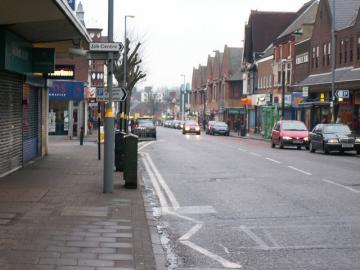
A personal view on the Kings Heath high street plans.
Sustrans have been working on a DIY Streets project in Kings Heath high street, funded by Lottery money, with additional funding from Birmingham City Council, to look at public realm issues in the area. In January, the DIY Streets team have put out a possible plan for the high street, and while I personally don’t support the proposals for Kings Heath high street, the proposals do have support within Push Bikes. This personal opinion article is to explore the aspects of the proposals which are receiving support, but also explain my reservations about the proposals as a whole.
Before I start, here are some links to the DIY Streets' Facebook page and blog, so that you can have a look at the plans yourself. In this blog post I am discussing the plans as I saw them in January 2015.
The proposals re-allocate space to people on Kings Heath high street, a local centre that has ample car parks located just off it. Evidence shows that there if car parking spaces are moved a few metres away, it does not have any impact on trade for local shops, while providing space for people has a positive effect on local trade. A recent example I can think of is in New York where roads that had re-allocated space to people rather than motor traffic saw a positive increase in trade. The relocation of car parking did not adversely impact trade while the improvement in space for people led to an increase in trade. This is a lesson that we have had demonstrated time and again in Birmingham - who would return motor traffic to New Street? - but which we seem to forget.
The plans will make crossing the road easier for people, as the distance from one kerb to the other will be reduced. A 1 metre wide median strip will run down the centre of the carriageway. This will be a flat strip, rather than a raised strip which could cause problems for people using cycles. It is hoped that this median strip will enable better linkage between the two sides of the high street, which will help encourage more people to the high street, as well as helping to better connect people living on either side of the high street. Another positive aspect is the 20mph speed limit which, while not directly part of the Sustrans project as such, should be seen as part of the overall plans as a measure that will improve the high street and which will have been publicised more widely due to the Sustrans team’s work. 20mph is important for reducing speeds on the highstreet in the evenings and at night when it is not as busy, but people still want to enjoy the pubs and restaurants and need to cross the road, or just enjoy sitting outside in summer. The problem of speeding down the high street is most likely from motor traffic passing straight through, so the place-making aspects of the high street plans will have some impact but not much. More importantly, however, the consensus building that has gone on could be tapped into for putting pressure on the police to enforce the 20mph speed limits in and around Kings Heath.
The consensus building itself has been positive because it has been based around imagining change in the road environment. The activities around the pop-up parks in the parking spaces in Kings Heath high street have enabled people to really imagine what a change to the road environment would look like, which Sustrans have been able to tap into. Sustrans have been running similar DIY Streets schemes elsewhere to good effect.
The proposals will also be positive for public transport users, as a reduction in cars manouvering in and out of parking spaces will reduce congestion on the high street and help reduce delays for buses. It is surprising what an effect a single car looking for a parking space can have on the movement of motor traffic on a street, and these changes will help to reduce that problem.
The changes will also have some benefit for people who are comfortable cycling on the high street now. Removing some parking will reduce conflicts with cars pulling in and out of those parking spaces and remove the risk of car doors being opened in front of cycle users, knocking them off, at those locations. The median strip down the centre of the carriageway will provide a space for cycle users to filter past traffic jams, rather than filtering down the kerb side of traffic.
All this having been said, I still find it difficult to support the proposals as I think that they don’t provide a safe space for cycling along the high street. I have been told that travelling along the high street is not a line of demand for most cycle users, but as I cycle along the high street myself when I go to Bike Lounge in Kings Heath, perhaps there is some self-interest in my suspicion that there is suppressed demand for cycling along the high street rather than just crossing it. I’ve also been told that cycle lanes physically could not fit in a couple of locations along the high street, although I am waiting for exact details on which locations those are. Kings Heath high street lies on the Alcester Road main corridor, which is having cycle lanes installed between Kings Heath and Moseley, and from Moseley towards Birmingham city centre. There may also be cycle lanes installed on the south side of Kings Heath high street, down Alcester Road as part of future sections of the Birmingham Cycle Revolution. I think that cycle lanes should be extended into Kings Heath high street as far as is possible to provide a continuous link with the cycle lanes either end of the high street. The main issue I see is with bus stops, where a couple of bus stops are on very narrow sections of pavement at the moment. I would suggest relocating those bus stops, but of course it may be that that is too difficult to attempt.
Putting proper cycle lanes along the high street would bring benefits not only to cycle users but other groups as well, I think. Firstly, they would enable people to cycle up and down the high street in comfort, rather than cycling in among motor traffic. Research consistently shows fear of mixing with motor traffic on major roads to be the most significant factor in discouraging cycling. Enabling anyone to cycle up and down the high street would improve trade for local shops, as cycle users will stop more frequently at shops on their route than car drivers will. Displacing cycle through-traffic onto parallel side roads with fewer shops will result in missed opportunities for shops on the high street. Enabling cycling along the high street would also provide a more attractive alternative for people who drive their car straight through without stopping. These drivers are unlikely to know the parallel cycle routes, and having cycle users breeze past them on a cycle lane is a good advertisement for cycling. This is important for reducing congestion, noise and air pollution in Kings Heath which would benefit pedestrians greatly.
Proper cycle lanes also improve the comfort of the pavement for pedestrians. It is uncomfortable to walk along the kerb when motor traffic is passing you a hair-breadth away. However walking along the kerb next to a cycle lane is much less threatening. Indeed, if you are facing the flow of cycles, walking in a cycle lane is comfortable - it is easy to hop back onto the pavement when a cycle is approaching, as you know that once off the cycle lane, they won’t hit you, and if you get the timing wrong, being hit by a cycle user is far less damaging than being hit by a motor car. Having proper cycle lanes also helps pedestrians to predict the movement of cycles more, as proper cycle lanes provide a more attractive alternative to cycling on the pavement. Although the wider pavements under the current proposals will provide extra space for pedestrians, I believe that proper cycle lanes would provide an comparable increase in comfort for pedestrians.
I want cycling to be available to anyone for any journey that they want to make. The best way to increase cycling rates is to provide comfortable, attractive, space for cycling, and that means plugging as many of the gaps as we can. Kings Heath highstreet is a major destination, but many people say that cycling from one end to the other is unappealing because of mixing with the heavy motor traffic. The current proposals will improve the conditions slightly, but not sufficiently to encourage a large shift to cycling.
That having been said, they do present a good example of community engagement working to build support for some very positive changes to Kings Heath high street at the expense of relocating a few parking spaces. It is indicative of the poor state of the transport debate in the UK that a few parking spaces can create opposition to public realm improvements, but this project is part of changing that.
There is an important lesson to be learnt from this experience that I’d like to highlight as well. It was necessary for Sustrans to carry out pop-up park activities in the parking spaces to enable people to imagine what a difference relocating those parking spaces would make. There wasn’t any similar activity to try out cycle lanes, and so I am guessing that many of the people who responded positively to the pop-up parks would find it difficult to imagine what installing cycle lanes on the highstreet would feel like. I think that it is important to say that this is not a criticism of Sustrans’ project - the layout of KingsHeath high street would make it very difficult to put in pop-up cycle lanes, as the current kerb line changes so much to fit in crossings, parking spaces and bus stops. Instead I want to highlight this because there are other local centre locations around Birmingham that I believe would benefit from cycle lanes on the major roads that pass through them. They will also need these pop-up park style activities to enable change to be imagined, and it is important that we look for ways to include pop-up cycle lanes in that mix of activities.
There are going to increasingly be good examples of cycle infrastructure spread through Birmingham as the Birmingham Cycle Revolution main corridor works start this spring. These will be important examples for us to have, as a good flagship scheme can really help in gaining community buy-in elsewhere through enabling the community to imagine change. But if we can not manage to get a good example of cycle lanes working on main roads in a local centre, then it is going to be difficult to help imagine that possibility elsewhere. If the Green Travel Districts proposed in the Birmingham Connected white paper go ahead, it is important that the organisations developing them remember to help their communities to be able to imagine the difference that good cycle infrastructure can make, so that those communities have a whole range of options to choose from, not simply the limited palette that we have had in the past in the UK.